

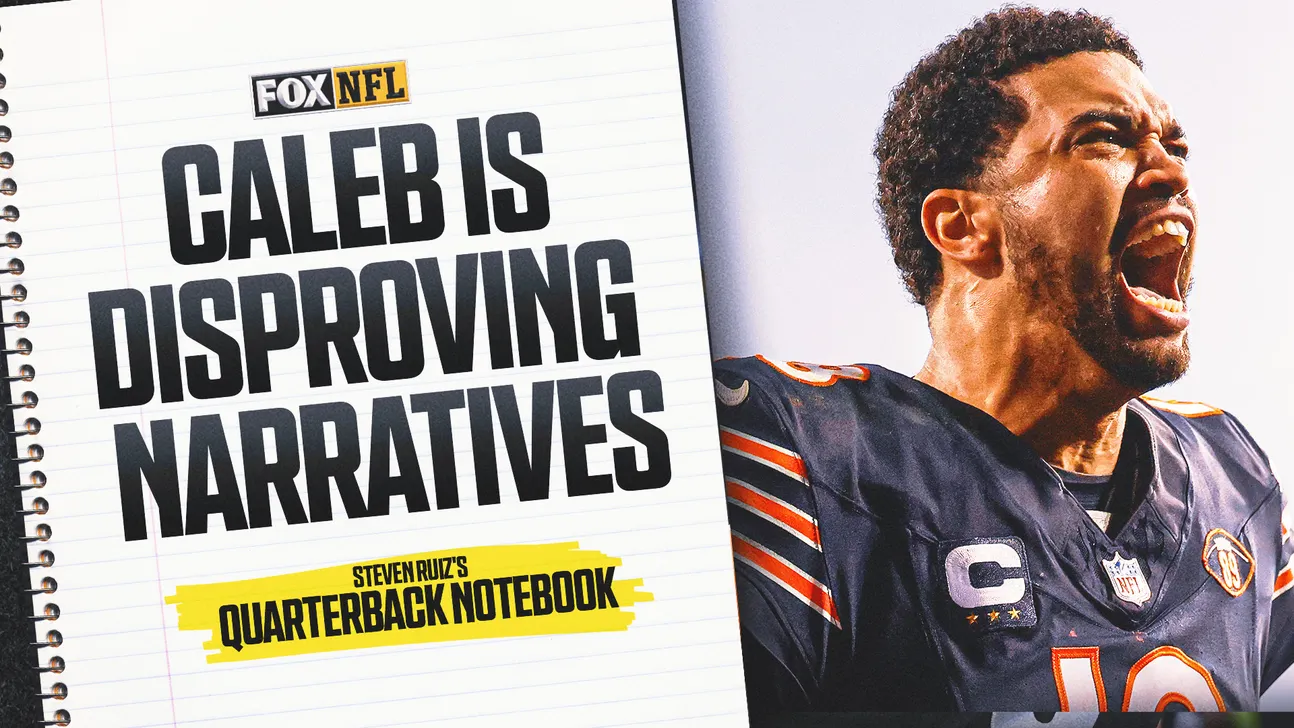
Welcome to the Quarterback Notebook — a look back at the week in NFL QB play, highlighting the most interesting passers, plays and storylines I noticed on film. This edition busts some myths about Caleb Williams, checks on Aaron Rodgers’ decline, and evaluates Jayden Daniels’ growth (or lack of it).
Caleb Williams
The story around Caleb Williams has swung from skepticism about his “playground” style before the Bears took him No. 1 in 2024, to renewed doubts after a rocky rookie season that included 68 sacks and a few moments that reinforced the “this isn’t college” narrative. Even after a clearer second-year jump — aided by Ben Johnson — critics zeroed in on his high time-to-throw and lower completion rate as evidence he wasn’t polished enough for Johnson’s scheme.
But Williams has been methodically erasing that criticism. He’s cut his sack rate roughly in half since Year 1 and now leads the league in completion percentage. The only sticking point left for skeptics is his average time from snap to throw — 3.24 seconds, tops in the NFL per Next Gen Stats — which traditionally flags quarterbacks who don’t process quickly enough. That metric matters, but it’s not definitive.
Williams’ Monday night performance against Seattle should quiet remaining doubts. He was the first QB to top 200 passing yards against that defense, completed over 70% of his throws and absorbed only one sack. He showed both quick decisiveness when plays were designed for rapid release and his ability to improvise when needed. On a standout play he worked through his progressions, left the pocket, and delivered a perfect throw to Colston Loveland while sprinting over 13 mph — a 5.49-second play that pushed his game-night average to 3.29 seconds. Did he look like someone holding the ball recklessly? Not really.
A PFF cut-up of Williams’ “scramble-drill” dropbacks this season backs that up: he rarely abandons a clean pocket or ignores an open receiver. PFF shows he scrambles from a clean pocket on just 1.8% of dropbacks — nearly the same as a largely immobile veteran like Matthew Stafford. Williams mainly leaves structure when he’s forced out, and once he’s running, he’s one of the NFL’s best playmakers. He’s also elite inside structure: no QB produces more expected points added per dropback from a clean pocket, and on those plays his time-to-throw drops to 2.72 seconds, tying Jared Goff — exactly the kind of precision critics said he lacked.
Aaron Rodgers
The Steelers are 6-2 and in position in the AFC, but the underlying debate remains: how much has Father Time taken from Aaron Rodgers? I raised concerns in September about his struggles on plays that require holding the ball longer and his diminishing tight-window accuracy. Defensive coordinators appear to be answering that question for us — through eight games Rodgers has faced 110 dropbacks in man coverage (PFF), far more than any other QB (the next closest is 65).
That divergence is notable because man coverage usage is down across the league as offenses exploit it with condensed formations, motion and route combos. Yet opponents dial up man against Rodgers because tight coverage disrupts timing, forces longer holds and reduces margin for placement — problems for a quarterback who no longer threatens with consistent rushes out of the pocket. Rodgers ranks poorly in PFF’s “plus accuracy” and shows little inclination to leave the pocket, making man-heavy plans sensible.
Rodgers’ preferred offensive look — shotgun with stretched receivers and little motion — gives him a clean pre-snap view but also makes it harder to attack man with pick concepts and leverage-based route combos. Sunday’s win over Cleveland showed a clear path forward: designed motion and bunch concepts that created traffic for defenders and opened easy throws (examples with Darnell Washington in bunch motion). If Pittsburgh keeps seeing man coverage, they need more of those designs — but that requires Rodgers to adapt to play calls that compensate for his limitations, which may be a tall order.
Jayden Daniels
If you know Betteridge’s law of headlines, you can guess where the “can he?” questions go. I have concerns about Daniels’ development, though his physical skill set still projects to a top-10 ceiling if he can stay healthy and get consistent reps. The issue is that he hasn’t shown a clear second-year leap and has trailed draft peers like Caleb Williams and Drake Maye.
Daniels’ injury history matters more because scrambling is such a central part of his game. Dan Quinn has repeatedly urged him to protect himself, but Daniels’ scramble rate rose in 2025 and remains among the league’s highest in 2026. Per PFF, he leads the NFL in scramble rate from a clean pocket at 9.3% — well ahead of Kyler Murray (5.9%), Drake Maye (5.1%), Jalen Hurts (5.0%) and Malik Willis (5.0%). He’s in a class of his own on that metric.
Many of those scrambles have been positive and kept Washington moving, but they increase his exposure to hits and the risk of missed development time. Scrambling has been a reliable floor for Daniels, but for him to take a meaningful step forward, more of those out-of-structure moments should result in downfield throws or designed plays that protect him, rather than runs that repeatedly put his body in harm’s way.
Geno Smith
I’ve wanted to write about Geno Smith’s resurgence, but the Jets haven’t been able to translate his good performances into wins. Still, Smith’s tape has been strong: he’s ninth in PFF grade, fifth in the league with 14 “big-time throws,” and he ranks among the best at limiting turnover-worthy plays. That mix of downfield aggression and sound decision-making makes him an appealing fit for teams that prioritize vertical passing — think offenses like Baltimore or Minnesota. (Note to Kevin O’Connell and Declan Doyle.)
Justin Herbert
At this point we could probably name a recurring section after Justin Herbert. Aside from two awful interceptions, the rest of his tape was solid this week — a reminder that even top QBs can have costly miscues on otherwise good outings.
Fan Take (two sentences)
Caleb Williams’ mix of structure efficiency and explosive out-of-structure playmaking suggests his early doubts are fading — that matters because it reshapes how teams and defenses game-plan against the Bears. Meanwhile, the Rodgers and Daniels stories show the league’s two-way tug: defenses will exploit a declining passer’s limitations while mobile QBs must balance escapability with longevity — both trends that could influence play-calling, roster construction and how teams protect and develop their young signal-callers.
Source: www.foxsports.com
