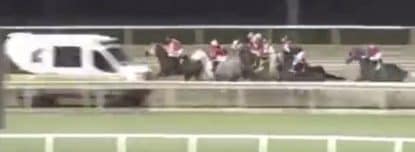
Jockeys at Evangeline Downs in Louisiana narrowly escaped disaster when an ambulance unexpectedly entered the track during a horse race. Around one and a half furlongs into the race, the ambulance was spotted near the top of a turn, forcing all eight jockeys to quickly avoid it, though it was a close call for several riders. As a result, the race was invalidated.
During the replay, a commentator minimized the incident, noting that the ambulance was simply out of place. It appears the ambulance driver either started late or misunderstood the race would be on the grass inside the dirt track. Irish racing commentator Kevin Blake described it as possibly the scariest near miss he has ever witnessed in horse racing.
Quarter Horses, known for their speed over short distances (typically around 400 meters), were likely sprinting at roughly 40 miles per hour when the jockeys had to dodge the vehicle. Fortunately, encountering the ambulance early in the race meant jockeys were facing forward and more alert, likely due to warnings from those ahead.
Historically, horse racing regulations in the U.S. were managed by each state, leading to varied rules. Many states have since joined the Horse Racing Integrity and Safety Administration (HISA) to standardize and improve horse and rider safety. However, Louisiana and some other states have not fully embraced HISA due to ongoing legal disputes. For example, jockey Paco Lopez, suspended by HISA for six months for using his whip improperly, was still able to race with a whip in Louisiana, which falls outside HISA’s jurisdiction.
Graham Motion, Kentucky Derby-winning trainer, commented on the situation, noting that although this was a quarter horse race, it was notable for being held at a track not governed by HISA. He praised HISA’s efforts to enhance jockey safety both on and off the track.
Fan Take: This alarming incident underscores why consistent and enforced safety regulations are essential in horse racing. For fans, it highlights the risks jockeys face and the urgent need for unified oversight to protect both riders and horses across all states.