

In recent years, the Knicks haven’t been known for having a deep roster. However, over the past month, head coach Mike Brown has increasingly relied on a 10-player rotation. In New York’s last two closely contested games against the San Antonio Spurs and New Orleans Pelicans, 11 Knicks players saw action.
At the start of the new season, expectations for the Knicks’ first- and second-year players were modest. Yet, several young players have stepped up recently, contributing to wins and reshaping the team’s roster structure for both this season and the future.
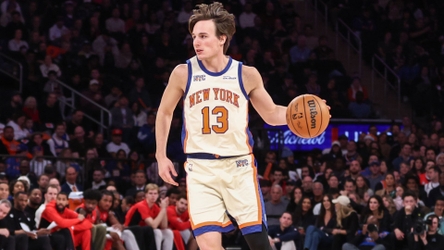
Tyler Korek has been leading New York’s youth movement. The 24-year-old point guard has become part of the rotation in recent games and played key roles, such as during the NBA Cup game against the Spurs. Notably, Korek scored 16 points with nine assists on Christmas Day and then, as a starter against the Minnesota Timberwolves, posted 20 points, 11 rebounds, and eight assists.
Second-year player Kevin McCullar Jr. also made an impact, scoring 13 points, grabbing eight rebounds, and making two steals during a recent win over the Atlanta Hawks. Rookie second-round pick Mohamed Diawara impressed with four three-pointers and 18 points in just 16 minutes during Monday’s victory against the Pelicans.
While these young talents may not consistently deliver standout performances, the Knicks don’t need them to carry the team on their own. In a recent loss to the Spurs, Korek managed only three points in 15 minutes, and both McCullar and Diawara played less than 10 minutes each.
The contributions of these three young players provide vital depth to a Knicks bench that sometimes seemed thin. With Landry Shamet and Miles McBride sidelined by injuries and reserve forward Gershon Yabusele struggling, the timely efforts of Korek, McCullar, and Diawara have been crucial.
A further advantage is the size of Diawara and McCullar on the wing — Diawara stands 6 feet 9 inches with a 7-foot-4 wingspan, while McCullar is 6 feet 5 inches tall with a 6-foot-9 wingspan. However, the Knicks face a challenge in perimeter size compared to players like Anunoby, Mikal Bridges, and Josh Hart. Their bench includes McBride, Shamet, and Jordan Clarkson, who has shown strong form earlier this season.
Looking ahead, the growth of players like Korek, Diawara, and McCullar will be vital for New York’s future. The Knicks are set to have the second-highest salary cap in the NBA for the 2025-26 season, trailing only the Cleveland Cavaliers. With just about $148,000 left under the luxury tax apron, managing payroll will be a key issue.
The latest collective bargaining agreement imposes severe penalties for teams surpassing the luxury tax apron, including restrictions on using the mid-level taxpayer exception to sign or trade for multiple players.
One solution to controlling rising salaries is effective drafting and signing young players at reasonable costs. Korek and Diawara will earn just under $3.5 million combined this season, while McCullar is on a two-way contract.
The Knicks already have five players earning over $19 million annually, including Mitchell Robinson. With Miles McBride potentially becoming an unrestricted free agent this summer or by 2027, developing young talent to fill important roles will be critical.
This situation places a spotlight on player development, an area where the Knicks have struggled for much of the 21st century. Successfully cultivating young homegrown players will be essential for New York to build around its core roster and remain a championship contender now and in the years to come.
—
Fan Take: Knicks’ emerging young talent signals a promising shift in the team’s approach, proving that developing homegrown players can renew competitiveness and roster depth. For basketball fans, this could mean more exciting, balanced games and a stronger, more sustainable future for the franchise and the sport.