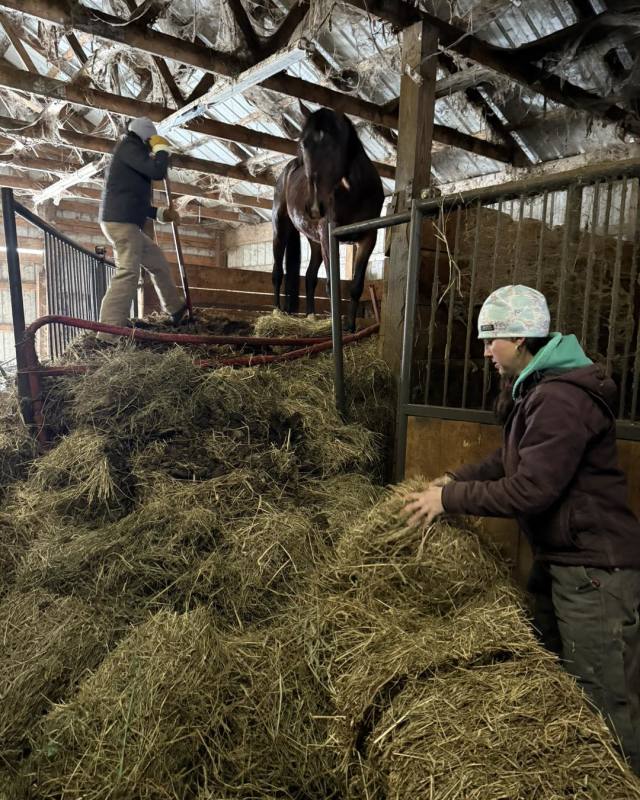
In late December, the New York State Police initiated an official inquiry into Edward J. Madeline, 35, following the rescue of 10 Standardbred horses from severe neglect conditions on a farm in Rensselaer County, New York. Four stallions were found confined in barn stalls atop heaps of old hay and manure reaching up to five feet in height. Rescuers believed these stallions had not been outside for years nor received necessary care like farrier or dental treatments.
Jennifer Straub of Dorset Equine Rescue, who helped with the challenging extraction of these horses, described the distressing scene: “Their heads were nearly touching the rafters. Seeing photos doesn’t compare to standing there and looking up at them—they seemed to be perched on a manure cliff. It was heartbreaking.” The other five Standardbred mares were kept in outdoor pastures alongside painted mares and cows, while one mare endured isolation in a barren paddock without shelter. Many of the horses had overgrown hooves, limited medical care, poor physical health, and restricted access to water, as reported by volunteers.
The American Trotting Association, through its program Support Our Standardbreds (SOS), contributed $10,000—$1,000 per horse—to assist the public agencies and charities caring for these abandoned registered Standardbreds. Although Madeline’s owner and trainer license lapsed in 2021, the USTA announced it will not issue him a new harness racing license should he apply. “Membership applications are currently on hold and will not be viewed favorably,” stated Dan Leary, USTA’s marketing and communications director.
The dire situation came to light when Madeline’s grandmother, Ellen Hartley, contacted Littlebrook Farm Sanctuary in Old Chatham for help. Lynn Cross from Littlebrook revealed that Hartley, 82, had been trying to care for the horses herself but was hospitalized after a stroke and unable to continue. Upon visiting on December 28, Cross found conditions far worse than described, noting that Hartley may have minimized the situation to avoid deterring aid. Recognizing it as an emergency, Cross arranged to relocate one mare found alone without shelter—a 22-year-old, one-eyed mare named Jeanne-Marie, who earned over $81,000 on the track and is the dam of eight foals earning over $400,000 collectively. Jeanne-Marie was adopted by Littlebrook on December 29.
Cross reached out to nearby rescue organizations, including Dorset Equine Rescue (Vermont) and the New Hampshire Humane Society, which agreed to assist. Tomten Farm and Sanctuary (New Hampshire) and the Maine Humane Society committed to housing some of the horses. On December 30, despite freezing snow and ice, six volunteers bravely undertook the rescue. They encountered manure piled and frozen as high as five feet, resembling concrete, which complicated freeing the horses. The team first freed a stallion by building a hay ramp he could climb to escape. For a second stallion, the fire department used the jaws of life to cut through metal bars obstructing his stall. The remaining two stallions were freed after carefully dismantling makeshift stalls made from round pen panels.
In total, nine horses were removed that day, with the final horse and a cow handed over days later. Although Madeline had his grandmother sign transfer papers during the rescue, USTA records showed Madeline as the owner of most of these horses, while Hartley was not listed as their owner or breeder. An anonymous source said Hartley had no involvement with the horses before Madeline abandoned them and that he had transported them years earlier in poor condition. Under New York law, surrendering the horses does not prevent potential animal cruelty charges. Sue McDonough, a former state trooper specializing in animal abandonment cases, explained that failure to provide proper nutrition is a misdemeanor, punishable by up to one year in prison. Police are still gathering evidence before submitting the case to prosecutors. Madeline did not respond to requests for comment.
Regarding the rescued horses’ current status, New York’s Rood & Riddle Equine Hospital took in six of the most critically ill, including a 23-year-old stallion named Days of Courage, who had a body condition score barely above emaciation. Bred and raced in New Zealand before coming to the U.S., Days of Courage earned $250,000 over 101 starts and is registered under Madeline’s ownership. Tomten Equine Sanctuary provided his permanent home and covered his hospital bills. Weak and prone to falling during transport, Days of Courage underwent two weeks of care involving careful refeeding, dental work, arthritis treatment, and hoof trimming. Jennifer Vickery of Tomten expressed hope for him to regain strength, be gelded, and enjoy a social life with other horses.
Other horses not requiring extensive hospitalization were placed in temporary foster care before moving to rescue groups. The three remaining stallions from the barn included Sharpejoltacourage—a 7-year-old gelding and offspring of Days of Courage, Drifter, 15, and Gibson Blue Chip, 17, a gelding with 16 wins and over $159,000 earned. These three were adopted by Dorset Equine Rescue and the Maine Humane Society. Rescued mares included Jeanne-Marie at Littlebrook Farm; Dancin’ Daisy, a 12-year-old with six wins earning $26,000, currently with Maine Humane Society; I’m Not Who Sinkium, an 8-year-old with limited racing history, and Joltov Sander, a 19-year-old broodmare with moderate racing success, both with Maine Humane Society.
Two mares without microchips or freeze brands are in Dorset Equine Rescue’s care: Preacher’s Daughter, who suffered severe head injuries before rescue, and Jasmine, believed to be her offspring. An older Paint mare and a cow were taken to Littlebrook Ranch. Most horses are reportedly recovering, although many face ongoing health and hoof care challenges, with some potentially available for adoption.
Dorset Equine Rescue praised the extraordinary collaboration among rescue teams working in harsh winter conditions, emphasizing that such operations succeed because people refuse to turn a blind eye and act with compassion and courage. For further updates, photos, and donation opportunities, supporters can visit the Facebook pages of Dorset Equine Rescue, Tomten Farm and Sanctuary, Littlebrook Farm, and Maine Humane Society.
This article originally appeared in the Horse Care section of the Paulick Report on January 28, 2026.
Fan Take:
This story matters deeply to the horse racing community because it highlights the critical need for responsible ownership and oversight within the sport. Ensuring the welfare of retired and active racehorses protects the sport’s integrity and fosters greater public trust, which is essential for harness racing’s future growth and reputation.