

Although the U.S. national team won’t compete in the 2026 World Cup for another four months, there’s already buzz about the 2030 tournament.
On Friday, CONCACAF, which oversees soccer in North and Central America, announced the qualifying process for the upcoming World Cup.
Significant development: The intense qualifying battles between the U.S. and Mexico may be a thing of the past.
This shift is due to the World Cup’s expansion to 48 teams, which grants the region six automatic spots—double the previous amount. As a result, CONCACAF’s traditional six-team final qualifying round, the “Hexagonal,” has been restructured.
The new final stage will consist of three groups made up of four teams each. The winning and second-place teams from these groups will earn spots in the World Cup. The 2030 tournament will take place in Spain, Portugal, and Morocco, while the centennial matches will be hosted by Argentina, Uruguay, and Paraguay.
Unless there’s an unexpected twist during the CONCACAF qualifiers, the U.S. and Mexico won’t be competing in the same group in the final round, eliminating the chance for high-stakes matches in front of U.S. fans in MLS arenas or iconic showdowns at Mexico City’s famous Estadio Azteca.
In previous qualifying rounds, the U.S. defeated Mexico 2-0 in Columbus multiple times, but they suffered a loss in 2016. “Dos a Cerro” resurfaced in 2021 in Cincinnati.
To date, the U.S. has never won a match on Mexican soil.
While the two teams will continue to meet in the Gold Cup, Nations League, and friendly matches, the likelihood of a face-off with World Cup qualification on the line seems low.
If all goes as planned, the U.S., Mexico, and Canada will lead the three groups in the final stage.

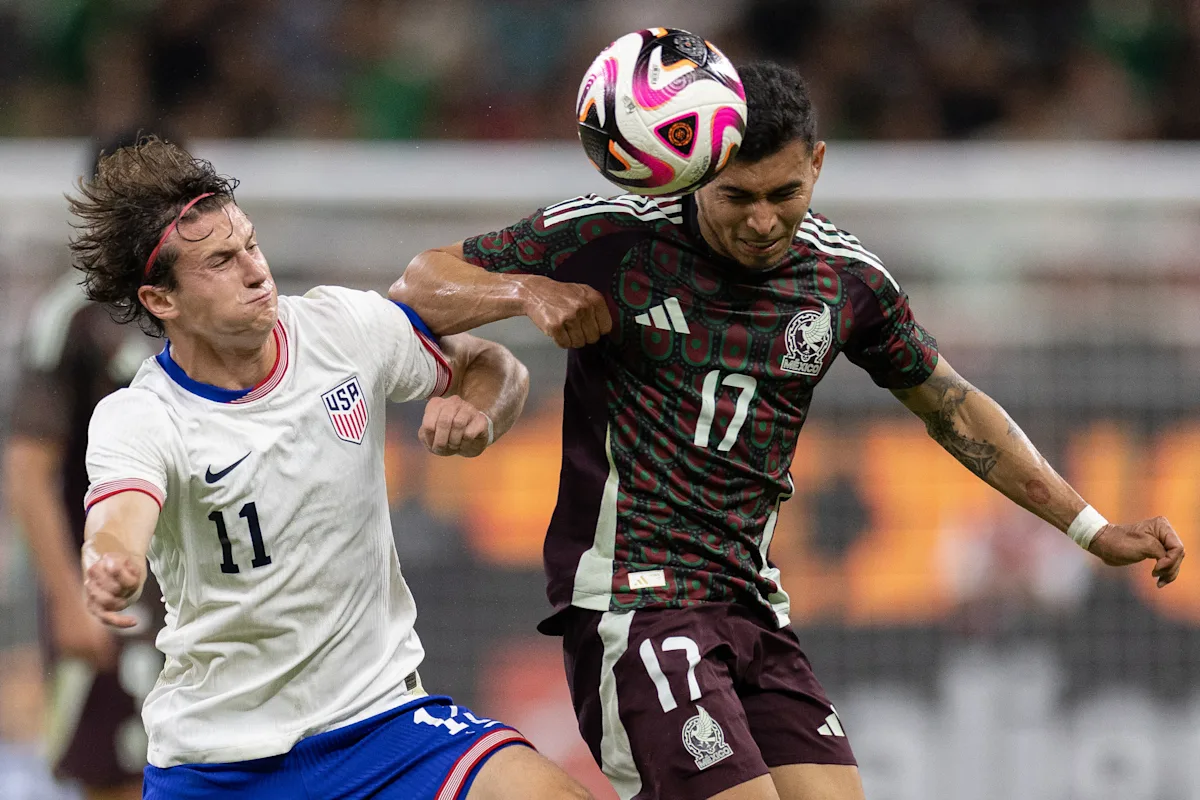
The U.S.-Mexico rivalry could soon lack World Cup stakes.
(John Dorton/ISI Photo/USSF via Getty Images)
As host nation, none of these teams need to go through qualifying for the 2026 World Cup. Teams like Panama, Haiti, and Curaçao have already qualified, and Jamaica along with Suriname will compete in FIFA playoffs next month.
CONCACAF had to adjust the 2022 World Cup qualifying format due to scheduling complications from the pandemic. They replaced the hexagon with an octagon, allowing eight teams to vie for three automatic spots in a 32-team lineup (Canada finished in first place, followed by Mexico and the U.S.).
The expansion of the World Cup has led to even more notable changes.
For the 2030 tournament, CONCACAF teams ranked from 14th to 35th will participate in a two-legged playoff from September to October 2027, based on their rankings. The 11 winning teams will then join the region’s top 13 teams in a second round slated for late 2027 or early 2028.
This second phase will consist of 24 teams divided into six groups of four, with each team playing six matches (home and away) against the others in their group. Although CONCACAF hasn’t revealed how groups will be determined, the U.S. and Mexico are expected to lead separate groups, giving them a competitive edge for a strong finish.
Currently, the U.S. is ranked 15th, Mexico 16th, Canada 29th, and Panama 33rd, with no other CONCACAF team within the top 50.
Both the group winners and runners-up from this second round will advance to the final stage in 2028-29. If the U.S. and Mexico each top their groups in the second round, they will have a strong chance of leading their respective final round groups. (Details about the grouping process are still unclear.)
If they struggle during the second round and end up second in their groups, the U.S. and Mexico could face off against each other again. It could lead to significant matchups in Ohio and Mexico City.
As a fan, this news highlights the changing landscape of soccer in North America, making competition fiercer and the stakes higher. It could pave the way for a more thrilling experience for spectators and a greater emphasis on regional talent as nations seek to secure their spots on the world stage.