Jack Crawford set the fastest time of the day at the Pirelli tire test in Abu Dhabi, as Mercedes and Ferrari activated systems that replicate the 2026 aerodynamic changes.
All teams were allowed to develop systems to help them understand the changes in balance and performance that could be caused by the active aerodynamics that will come into effect from next season, using lower drag modes on the straights and higher downforce in the corners.
Of these, only Mercedes and Ferrari had distinctly different front wings, with Mercedes having a hydraulic system containing two tubes that protruded from the end of the nose and looped around to the front wing flaps. Both allowed the flaps to be moved to a low-drag setting, although Ferrari’s design was more delicate.
These changes meant both teams were exempt from the 300 km/h (186 mph) limit imposed by Pirelli to reduce downforce, ensuring that the data collected was more representative of 2026. Ferrari and Mercedes were only able to use the ‘Straight Line Mode’ (SLM) system in certain sections enforced by the FIA.
The system was the most eye-catching part of the day, which drew just one red flag when Haas reserve Ryo Hirakawa spun backwards into the barrier at Turn 1, and featured new world champion Lando Norris as one of 15 drivers in the 2026 race to use rubber cars.
After winning his first title on Sunday, Norris wore a special gold version of his helmet design and also added a touch of gold to his racing boots. He showed no ill effects from Sunday night’s big celebrations, recording 71 laps in the morning session.
Piastri took over from Norris in the afternoon session, Ferrari also split the running with Charles Leclerc and Lewis Hamilton, Williams had both Carlos Sainz and Alex Albon, Sauber gave track time to Nico Hulkenberg and Gabriel Bortleto, and Haas tried to do the same.
At Haas, after a productive morning for Olly Bearman, Esteban Ocon had a frustrating morning, completing only four laps in total before his afternoon ended with an engine problem.
Red Bull will have Isaac Hajjar ride in the car all day long as a tire tester before stepping up to the team in 2026, making Racing Bulls the only team with a full two-car driver line-up for next year. Teams are allowed to run a race driver in the Pirelli Tire Test mule car and a rookie in the other as part of the Young Driver Test, but Hajjar’s replacement Arvid Lindblad was also a rookie, so he had a day of running to get ready while Liam Lawson carried out Pirelli duties.
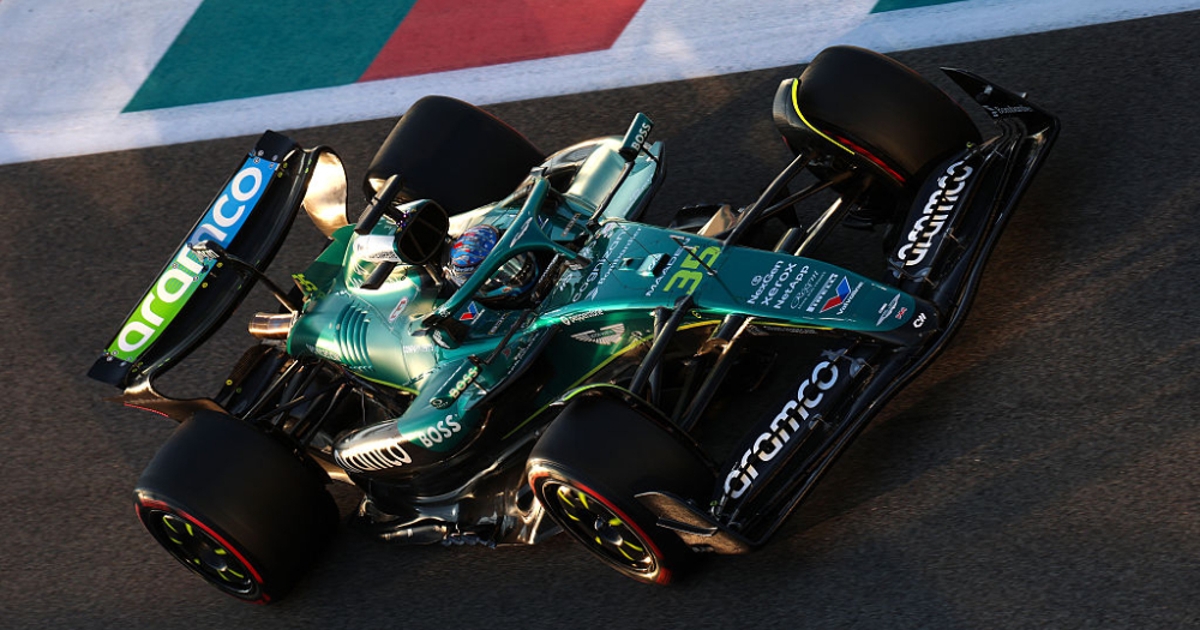
Aston Martin’s third driver Crawford set the fastest time of the day in an unmodified car fitted with 2025 tires, with the American setting a time of 1 minute 23.766 seconds in the afternoon session. That meant he finished less than two seconds behind Sauber’s Paul Aaron, with Williams’ Luke Browning third with a time of 1:23.930.
Mercedes’ Kimi Antonelli drove all day and was the top driver on 2026 tires, completing the most laps with 157 and finishing sixth fastest behind Pato O’Ward. The IndyCar star made another appearance for McLaren, adding 127 laps to his F1 experience.
“This test day is a great opportunity for all teams to try out the definitive 2026 tires, and the compounds will be officially decided on Monday,” said Pirelli’s head of motorsport, Mario Isola. “During the development tests organized by Pirelli throughout this season, teams independently ran different versions of prototypes at different stages of development, from new structures to a wide range of options for the same compound.
“Today was the first time they had the full range at their disposal on track, giving them the opportunity to more fully understand the characteristics of the new tires. By using the same mule cars and the same speed limits as during development testing, the team was able to easily compare the data obtained at Yas Marina with the data from individual test days over the past few months.”
“For our engineers, this test is fundamental to confirming performance gaps between compounds and degradation levels, and this has been the focus of our work throughout the year. By analyzing new tires with a small surface footprint, we were also able to confirm exposure to graining and overheating, two effects that can be increased due to the small surface area.”
“We will have to wait until the end of January to see these latest tires in action at the Barcelona test on new generation cars.”