
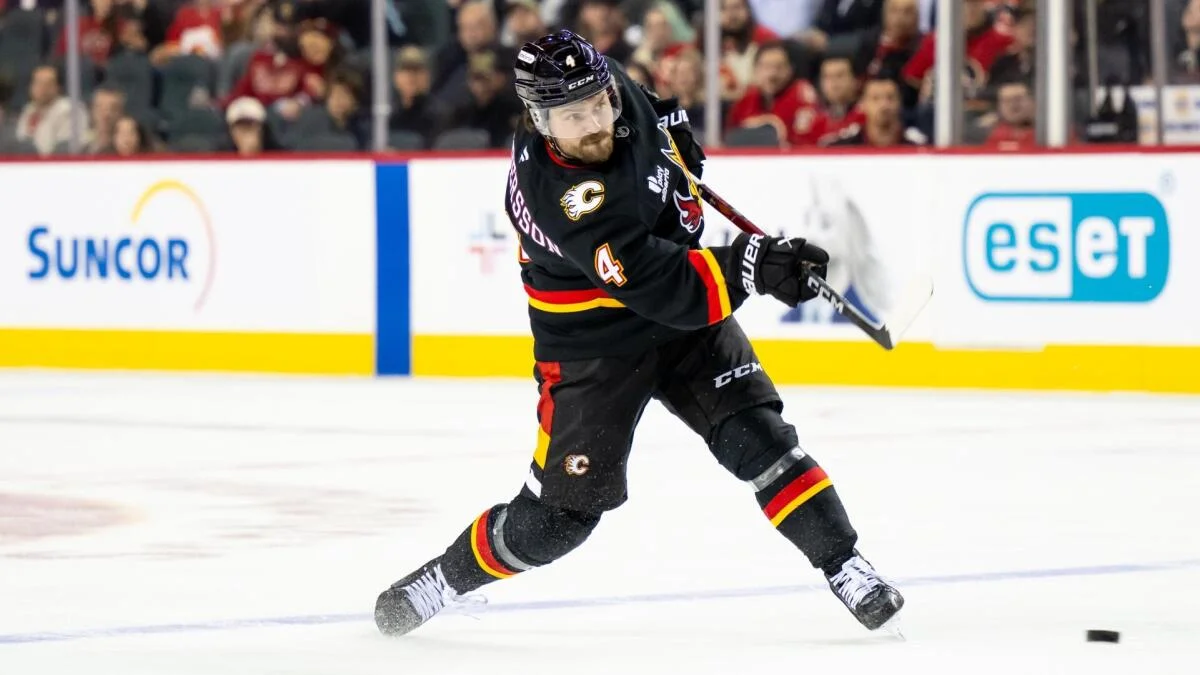
The Vegas Golden Knights have made another notable move in the trade market by acquiring veteran defenseman Rasmus Andersson from the Calgary Flames, as reported by Sportsnet’s Elliott Friedman. To make the deal happen, Calgary agreed to retain half of Andersson’s $4.55 million salary. In exchange, Vegas sent a 2027 first-round pick, a conditional 2027 second-round pick (which upgrades to a first-round pick if Vegas wins the Stanley Cup this season), defenseman Zach Whitecloud, and prospect Abram Weibe to Calgary.
This acquisition fills a key defensive vacancy for the Golden Knights after Alex Pietrangelo was sidelined with a severe hip injury. Despite Andersson being in the last year of his contract without a signed extension, Vegas took a risk by giving up future valuable picks and players for a rental, betting on an extension in the near future. Andersson was once a highly regarded defender under former Flames coach Darryl Sutter but has shown diminished stats since Sutter left, impacted by coaching changes and a weakening Flames roster.
Statistically, Andersson’s recent performance has dipped, with a less favorable expected goal share and negative point differential at even strength this season. Vegas hopes to reintegrate him into a strong defensive system that can amplify his offensive capabilities while concealing his defensive shortcomings. Meanwhile, the Flames, in rebuilding mode, likely see this as fair value, gaining key draft capital while acquiring solid depth and future prospects.
This trade benefits both teams—the Flames accelerate their rebuild with additional draft picks, while the Golden Knights bolster their roster for a tough playoff run in the Western Conference. Presently, Vegas holds the second-best odds to win the West at +470, trailing the favorites Colorado Avalanche (+125) and closely followed by the Edmonton Oilers (+500).
Fan Take: This trade signals Vegas’s commitment to making a deep playoff push by taking calculated risks on experienced players. For hockey followers, it highlights the intensity of the trade market and how teams strategically balance present success against future assets.