
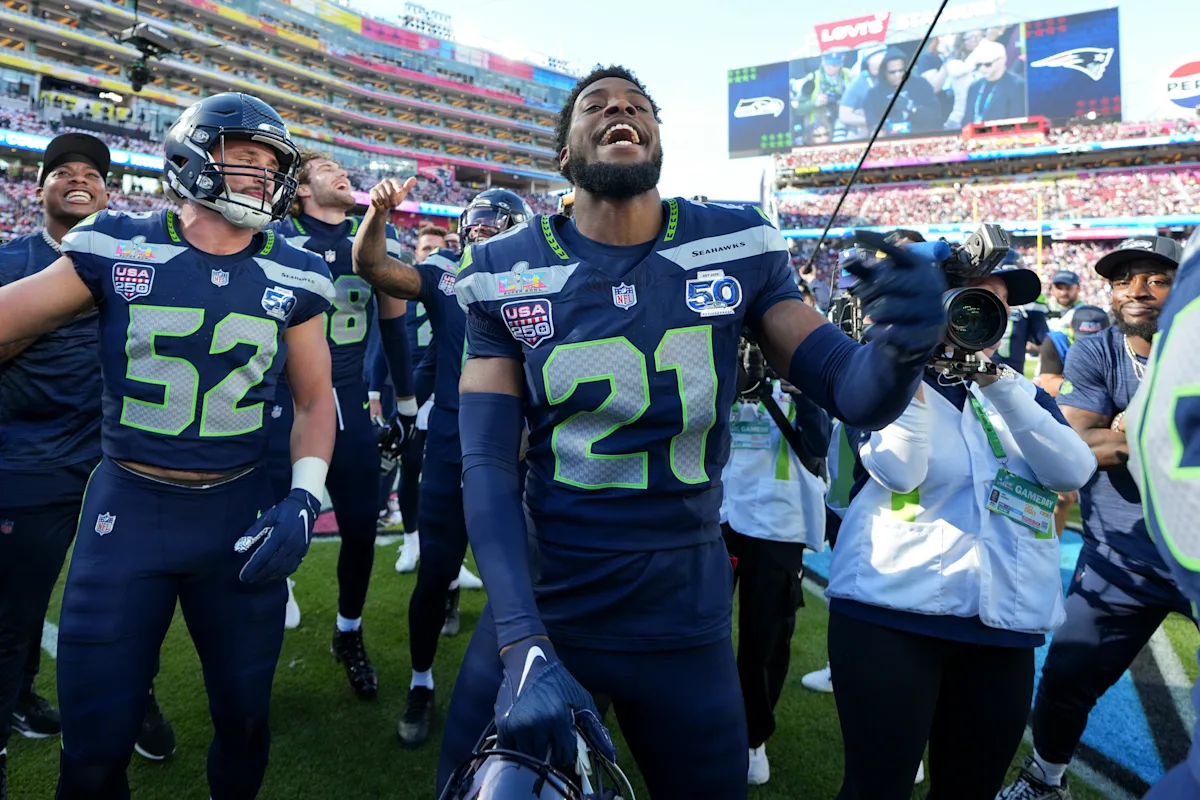
Seattle walked into Levi’s Stadium and delivered on the lofty expectations they carried all season. Neither offense managed a touchdown, and New England’s chances dwindled as Seattle kept chipping away with field goals, slowly extending a lead that felt increasingly insurmountable.
Mike McDonald’s defense, which dominated all year, showed why it’s regarded as one of the best units of this century. They repeatedly bottled up quarterback Drake Maye and the Patriots’ attack, reminding everyone that defense can be as compelling as any highlight-reel offense.
From the opening quarter it was clear who controlled the game. On New England’s first three drives—13 plays spanning the entire first quarter—the Patriots produced just 39 yards and posted -0.32 expected points per play, arguably their best stretch of the day. Their struggles continued into the middle quarters: over the second and third they again managed only 39 yards, this time on 26 plays, averaging a meager 5.6 yards per drive and picking up just two first downs in seven drives. New England didn’t enter the red zone until the fourth quarter and averaged only 7.8 yards per drive through the first three quarters.
The box score captures the dominance, but the game looked relentless in person. New England’s offensive line was repeatedly overwhelmed—rookies Will Campbell and Jared Wilson in particular struggled on the left side—while right guard Mike Onwenu had a rough day. Seattle’s game plan even exploited how the Patriots set their line; as cornerback Devon Witherspoon noted after the game, McDonald had pointed out that New England often cues plays off the offensive line’s stances and angles, and the Seahawks used that to their advantage.
Witherspoon was a constant disruptor, getting through blocks and creating chaos, and he was only part of the wrecking crew. TruMedia credited Derrick Hall, Boi Maffe, Byron Murphy II, Uchenna Nwosu, and DeMarcus Lawrence with pressure rates over 12 percent, with Leonard Williams adding an 8.1 percent rate. Those pass-rushers, alongside Witherspoon, generated consistent pressure and repeatedly broke through New England’s protection.
It wasn’t just the physical mismatch up front; coaching also looked lopsided. Patriots offensive coordinator Josh McDaniels couldn’t keep pace with McDonald’s aggressive schemes, and head coach Mike Vrabel’s late-game decisions and halftime adjustments didn’t change the outcome. New England’s play calling and game management felt ineffective, while Seattle exploited every opening.
Low-scoring football can still be enthralling, and this season Seattle’s defense proved to be television-worthy—capping the year by raising the Lombardi Trophy. While coverage may gravitate toward Sam Darnold as the game’s focal point, this team will be remembered for what truly carried them: one of the most dominant defenses in recent memory.
Fan Take: This game underlines that a championship can be built around a relentless defense, not just explosive offense—NFL teams may double down on defensive investments and coaching hires as a result. For fans, it’s a reminder that strategy, discipline, and pressure can produce thrilling, title-winning football even when the scoreboard looks low.