

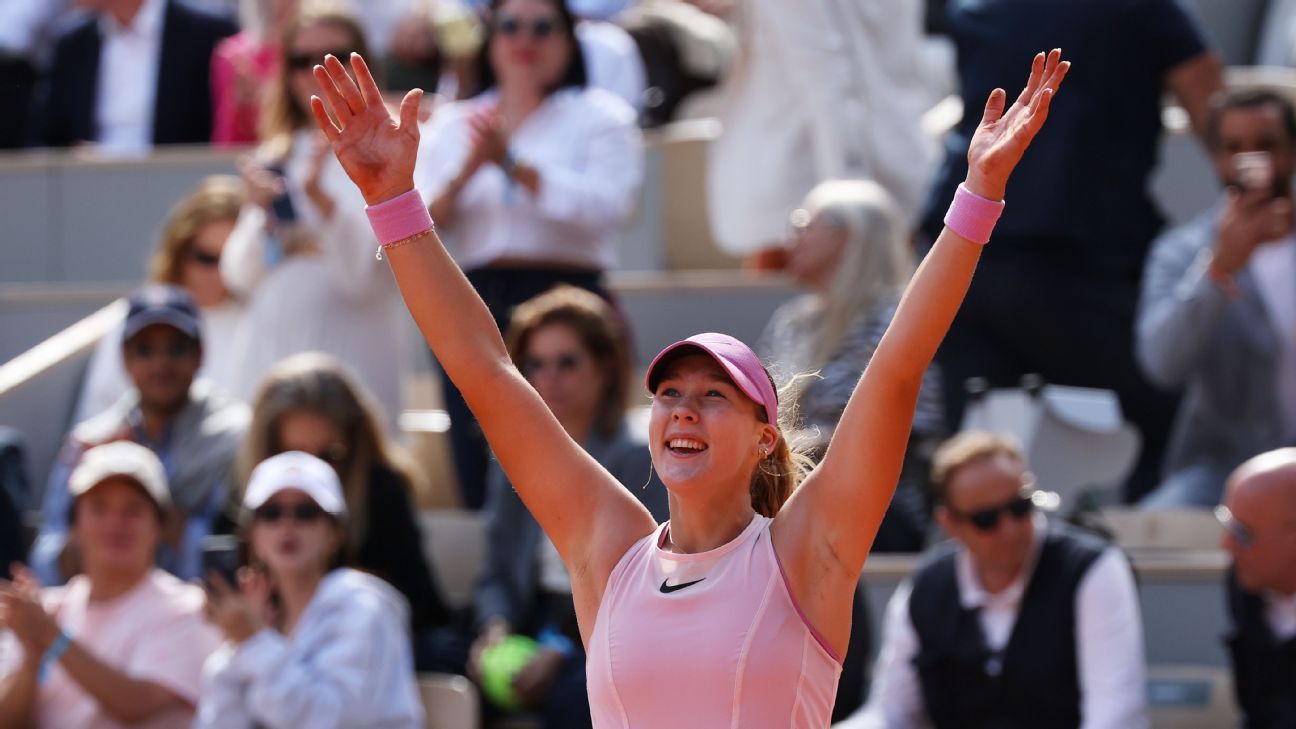
PARIS — The history of tennis is full of players who were expected to be great players but fell short. The pressure, injuries, and expectations are often too much to handle.
The hype machine started early for Mira Andreeva. A junior finalist at the 2023 Australian Open at just 15 years old, she burst onto the scene when she reached the third round at Roland Garros that year, and made some pretty bold statements in the process.
Asked about her goal for the French Open in 2023, she said, “I know Djokovic has won 23 Grand Slams, so I would like to go until I’m 25 if possible.”
It was a joke, of course, but an early sign of the personality that has helped her cope with the inevitable attention she receives ever since. He reached the fourth round at Wimbledon that summer and captivated media around the world with his sense of humor.
“At first it’s always like, oh my gosh, wow, people are recognizing me all over the place,” she said Saturday. “I’m here on social media and the internet, and everyone knows about me. But at the same time, at some point, I even want to step away from social media and completely forget that all that stuff exists. … But I wouldn’t say it bothered me that much. I’ll be honest. I like the attention.”
Andreeva is the youngest player to win the French Open women’s title since Monica Seles in 1992. She is also the first Russian athlete to win Roland Garros since Maria Sharapova won the second of her two crowns in Paris in 2014. Sharapova, who became Wimbledon champion at the age of 17, has been in the public eye throughout her career, and Andreeva, who was only seven years old at the time, recalls the moment:
Joy from Mila and her team 🥹 #RolandGarros pic.twitter.com/guPR7cIzyB
— Roland Garros (@rolandgarros) June 6, 2026
“I remember her winning here,” she said Saturday. “Obviously, she played great on clay and won twice. I knew she was here in Paris as well (this year with sponsorship commitments), so I was hopeful — I don’t know if she was watching the final, but I was hoping that she was watching. Obviously, I thought in my heart that if she was watching, it would be really great to see some good tennis, some level of good tennis.”
Growing up in public is never easy, as Sharapova can attest to. It helped that Andreeva’s game was balanced from the moment she joined the senior tour. As he grew taller, his serve improved month by month, and now it has become a weapon. But her understanding of the game, her tennis IQ, is what really stands out.
Like her opponent in Saturday’s final, Andreeva knows how to change the pace, change her trajectory, mix things up and make her opponent uncomfortable. In some ways, she plays like former world number one Martina Hingis, winning the ball early and forcing opponents out of their comfort zone.
His relationship with Conchita Martinez also helped. The former Wimbledon champion started working with Andreeva in April 2024 and the two hit it off immediately. Speaking over champagne at Roland Garros on Saturday, Martinez acknowledged that there were times when Andreeva’s attitude was not up to par, but praised how open she was to ideas and how hard she was willing to work.
“Even though I won here at Roland Garros, I still have a long way to go and I have to keep learning,” said Martinez, who is always a calming influence off the court. “I knew that in order for her to win big, things had to change. I doubted her at times. But I applaud her for being willing to change things, staying open, and continuing to work hard. When she works hard, you see her potential unfold. She’s a natural. She’s a great player.”
Andreeva sometimes struggled to control her emotions, throwing her racket, swatting the ball away in anger, and even hitting herself with the racket. But her work with Alexis Castori, the sports psychologist who helped Andy Murray eventually win his first Grand Slam title, has paid off astoundingly.
“I feel like I’ve been able to handle my nerves a little bit better in the last two weeks,” Andreeva said Saturday. “I actually consulted a psychologist before the semi-finals and the final because I wanted to be in the right frame of mind before what might be the most important match of my life. I wanted to prepare as best I could.
“She gave me a lot of advice and a lot of techniques. She tried all of that on the court and helped me experience all of this better and easier. That’s why I think she deserves a lot of credit in this regard.”
Whether you’re 19 or 39, maturity is very important in sports. Winning a major title at the age of 19 is unusual, and all eyes will be on Andreeva heading into Wimbledon. All evidence so far indicates she will cope well.