

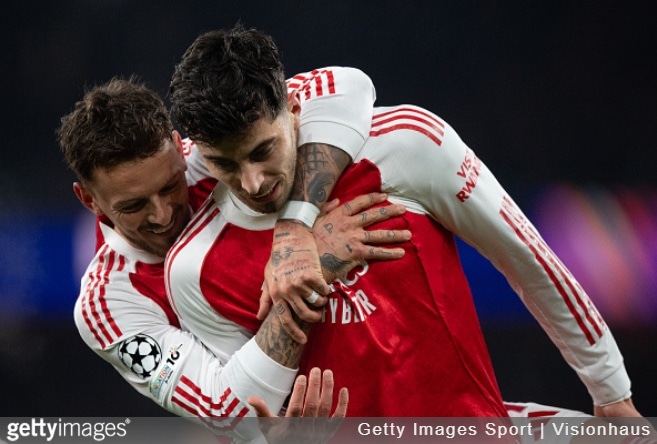
On evenings like this, as the soft lights of Europe illuminate London and a rotating Arsenal squad edges closer to victory, it’s easy to view the event merely as a special training session. However, football seldom unfolds in predictable ways, and Arsenal’s triumph over Kairat Almaty gave us more than just the joy of an expected win. It signaled that Kai Havertz might be poised to reclaim his pivotal role in Mikel Arteta’s vision, following a year fraught with injuries, loss of form, and lingering uncertainty.
For Havertz, this performance represented more than just productivity; it was a resurgence, a re-focusing, and a subtle assertion that he can still influence Arsenal’s trajectory. His goal, along with his contributions to two others, showcased his impact, but the intangible aspects—confidence, precision, and a sense of flow—were equally significant.
Amid Arsenal’s involvement in four competitions and a somewhat shaky attacking lineup, Havertz’s return couldn’t come at a more crucial time. It’s essential for Arsenal to leverage his skills.
A Year of Difficulty Turns into an Opportunity
Havertz’s journey at Arsenal has been marked by interruptions. Following his impressive performances, he faced setbacks that diminished his impact due to injuries and team reshuffles. Yet, this match seemed free of the burdens he’d carried for months. His movements were assured, his touches clear-cut, and his instincts sharper than they have been since the previous spring.
In the first half, Havertz was not just a participant; he needed to make a mark—and he did. A pinpoint pass from Victor Gokeres set up the opening goal, demonstrating foresight, while a commanding finish that curled into the far corner displayed his renewed confidence. Showing awareness and leadership, he opted to assist rather than shoot in an earlier play, further underlining his development.
This was significant, especially as Arteta needed it to be. Arsenal is entering a pivotal phase of their season, which includes a challenging trip to Elland Road, a Carabao Cup semi-final, and a complex title race. A fit and confident Havertz not only expands Arsenal’s options but can also shift the team’s overall dynamic.
After a year marked by inconsistent fitness, he appears ready to take on this challenge.
The Gokeres and Striker Dilemma
While Havertz’s resurgence was a key focus, the ongoing uncertainty around Arsenal’s No. 9 role presents another storyline. Victor Gokeres embodies contradiction; he is a striker capable of overpowering defenders and scoring impressively, yet his unpredictable finishing can disrupt Arsenal’s momentum.
He scored a well-crafted goal but also squandered a chance that could have sealed the game early. A misstep close to the goal, a failed touch from Havertz’s pass, and a near miss served as reminders of the need for a more distributed scoring threat for Arsenal.
Gabriel Jesus brought his own familiar duality upon his entry. He caused chaos with his movement, squandering an opportunity but netting another—only for it to be ruled offside. Arteta is justified in rotating his squad, safeguarding his available striker, and maximizing Havertz’s contributions in a central role.
For managers seeking versatility and for attackers accustomed to fluid roles, Havertz is more than just a luxury; he is a vital component.
Noteworthy Management Achievements and Commitment to Youth
A quietly significant milestone—Arteta’s 200th win as Arsenal’s manager—has been overshadowed by the surrounding narratives. Achieving this over 326 matches, the significance of this night aligns with the trajectory of his management. Once again, he embraced youth and relied on the academy, leading Arsenal to become the first team to complete this European-style group stage undefeated.
By introducing Brando Bailey-Joseph and Ife Ibrahim, the 18th and 19th academy talents debuting under Arteta, he underscored his commitment to growth alongside ambition.
However, he acknowledged that tougher challenges lie ahead—difficult matchups at Elland Road, a semi-final against a revitalized Chelsea, and daunting fixtures as winter approaches. Nights like this hold value as they allow experimentation, rest, and recalibration, yet they pale in comparison to the challenges that await.
Performance Exceeding Context
Indeed, the opposition may not have been strong, and the matches occasionally felt more like practice than real competition. Yet, to overlook the significance of Arsenal’s performance would mean missing a bigger picture.
This team has displayed signs of anxiety in recent games, with rigid possession, limited chances, and overreliance on the creativity of Bukayo Saka and Martin Ødegaard. With Saka rested and Martin Zvimendi given a rare break, Arsenal needed others to step up. And step up they did—Havertz, Martinelli, and Szoboszlai all made their marks.
They sought rhythm and found it; they required variety and achieved it. They needed confidence, and this victory provided just that.
Even Jorginho’s early penalty concession and a late goal came with unintended advantages. They highlighted Arsenal’s vulnerabilities, reminding them about the importance of concentration and that defensive discipline can’t be turned on and off at will.
Ultimately, these moments heightened the urgency for the upcoming matches.
A Glimpse of Arsenal’s Potential
It’s tempting to view Havertz’s comeback and Arsenal’s overall stability as mere coincidences in a match against a modest opponent. Nonetheless, Arsenal’s season is at a critical juncture—faced with too many injuries, contradictions, and heavy expectations on key players, they need a spark, an alternate route to goal-scoring.
That catalyst could be Havertz, Gokeres, Martinelli, or Jesus. The difference between a title contender and a champion often hinges on such turning points—when a player emerges as a consistent starter, when uncertainty shifts to hope, and when fragility transforms into strength.
Havertz appeared confident once more. Arsenal exhibited balance again. After months of struggles, Arteta departed the pitch with newfound assurance.
The Path Ahead: Major Tests and Expectations
Arsenal finds itself well-positioned across various competitions, but comfortable nights will soon give way to high-stakes encounters. The upcoming trip to Elland Road, the Chelsea semi-final, and a series of demanding winter fixtures will require intensity and precision.
They will need a player like Havertz—one who can influence games, facilitate attacks, provide both physicality and creativity, and alleviate pressure from others like Saka while enhancing Arteta’s tactics.
Havertz, who played against Kairat Almaty, represents the player Arsenal envisaged signing—someone who can score, assist, connect, and galvanize teammates. Despite injuries diminishing his role, they never erased his talent.
If this marks a turning point for Havertz, it could significantly influence Arsenal’s season.
Performance Signifying More than Just Points
While Arsenal has celebrated larger or more emotional victories, this particular win carries significant implications. It suggests that Havertz is not just fit again but reinvigorated; it hints that Arsenal’s depth is rediscovering its form and that Arteta’s plans are alive and evolving.
No one will remember the scoreline or the opponent in the future. However, Arsenal may recall this match for a vastly different reason—as a moment when they rejuvenated a key aspect of their season.
If Kai Havertz is truly set to lead once more, Arsenal’s ambitions across four competitions may suddenly seem attainable.
Fan Take: This news is crucial for soccer fans as it signals the potential revival of a key player at Arsenal, which could greatly impact their title race and overall success this season. If Havertz can maintain his form, it could elevate not just Arsenal’s performance, but also the competitive landscape of football as they aim for glory on multiple fronts.